High-Speed Science and Ultra-High Vacuum
Turbomolecular Vacuum Pump: Principles, Design, and Importance for Modern Science
Modern science and advanced technologies are impossible without high and ultra-high vacuum. The creation of deep vacuum conditions is a key requirement for many physical experiments and technological processes. Research into material structures, semiconductor manufacturing, and chemical composition analysis all require an environment that is practically free from gas molecules. One of the key devices capable of providing such conditions is the turbomolecular vacuum pump (TMP). At pressures below 10⁻³ mbar, gas enters the molecular flow regime, where the mean free path of molecules exceeds the dimensions of the vacuum chamber. Under these conditions, conventional positive displacement pumps lose efficiency, and molecular pumping methods become essential. One of the most effective methods is the turbomolecular pumping principle. A turbomolecular vacuum pump (TMP) is a high-technology device designed to generate high and ultra-high vacuum. Its operating principle is based on transferring momentum to gas molecules using rapidly rotating rotor blades. Due to the combination of extremely high rotational speed and a multi-stage design, TMPs can achieve pressures in the range of 10⁻⁷–10⁻¹⁰ mbar, making them indispensable in scientific research and high-tech manufacturing.
-
Types of Turbomolecular Pumps by Rotor Suspension Design
Conventional Mechanical Bearing Suspension — The rotor rotates using two mechanical rolling bearings (upper and lower bearings).
Hybrid Suspension— The lower bearing is mechanical, while the upper bearing is magnetic. The rotor has no mechanical contact with the stator at the upper support point.
Magnetic Suspension — The rotating element is positioned between two magnetic bearings. Mechanical backup bearings are installed but operate only in emergency situations.
-
Types of Turbomolecular Pumps by Design Configuration
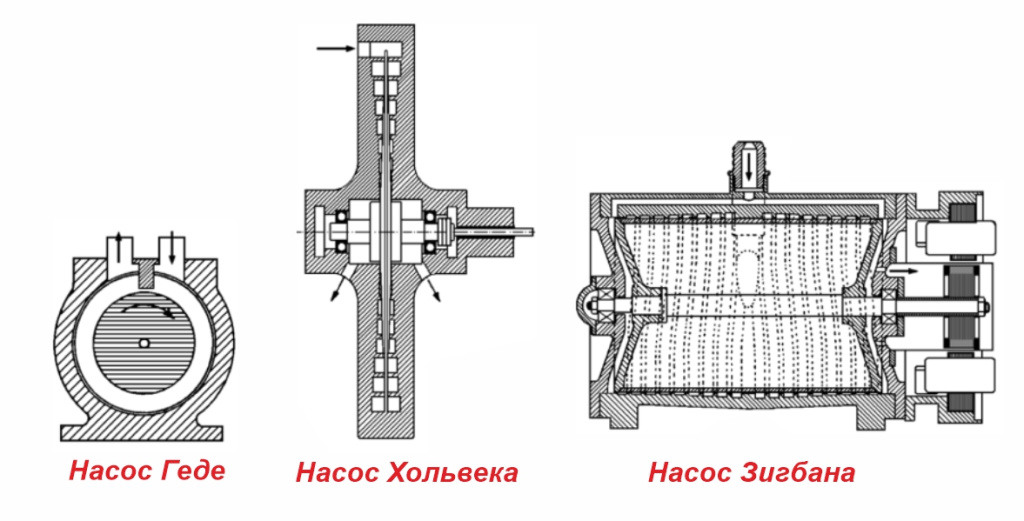
Gaede Pump.Cylindrical rotor design with annular channels on the rotor surface.
Holweck Pump. Cylindrical design with spiral grooves along the rotor surface.
Siegbahn Pump.Disk-type design with spiral channels extending from the outer diameter toward the center of the disk.
-
Operating Principle: Controlling the Motion of Molecules
A turbomolecular pump operates in the molecular flow regime, where gas molecules rarely collide with each other and mainly interact with the surfaces of the vacuum system. The main element of the pump is a multi-stage rotor-stator assembly consisting of: Rotor and Stator System
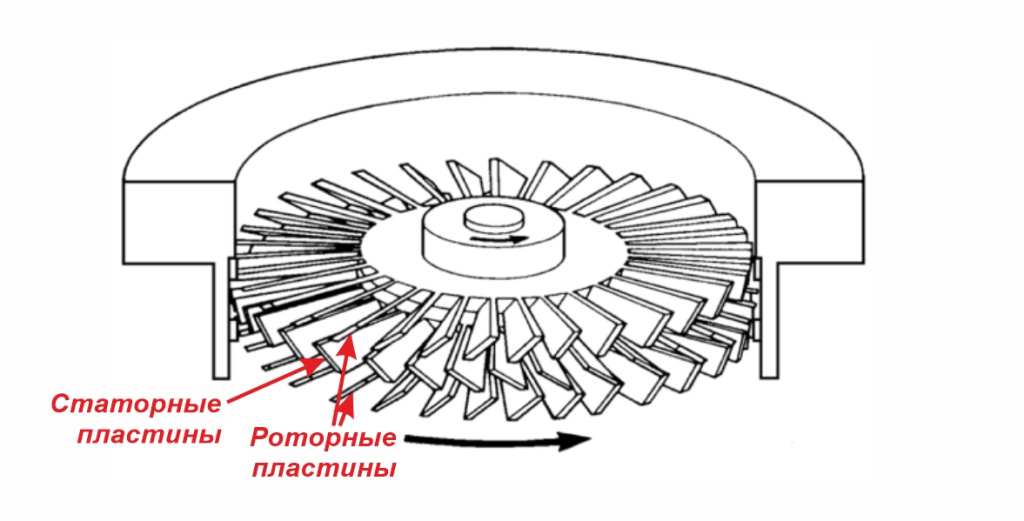
Rotor blades. High-speed rotating blades positioned at an angle to transfer momentum to gas molecules.
Stator blades. Stationary guide blades that direct molecular flow between rotor stages.
High-speed electric motor
Rotation speed: up to 20,000–90,000 rpm
Bearing systems
Ceramic or magnetic bearings.During rotor rotation, gas molecules collide with the inclined blades and receive momentum in the direction of pumping. The alternating arrangement of rotor and stator stages creates a sequential “pushing” effect, moving molecules toward the pump outlet. The molecules are then removed by a backing (fore-vacuum) pump. It is important to note that a turbomolecular pump cannot operate directly at atmospheric pressure. A preliminary vacuum stage is required. Before startup, the vacuum system must be evacuated by a backing pump to a pressure level of approximately 10⁻²–10⁻³ mbar.
-
Main Technical Characteristics
Ultimate pressure: up to 10⁻⁷–10⁻¹⁰ mbar
Pumping speed: from tens to thousands of liters per second
Rotor speed: up to 90,000 rpm
Process cleanliness: oil-free operation inside the vacuum chamberThese parameters enable the generation of ultra-high vacuum conditions required for fundamental and applied research. The extremely high rotational speed is achieved through the use of modern electric motors and low-friction bearing technologies.
-
Advantages of Turbomolecular Pump Technology
Ultra-high vacuum generation without oil contamination
High pumping speed, reducing pump-down time and achieving operating vacuum faster
Extremely low vibration levels especially in magnetic-bearing models, which is essential for precision measurements
Compactdesign compared with diffusion pumps
Ability to operate with various gases, including light gases such as hydrogen (H₂) and helium (He).
The main advantage of TMP technology is the combination of: — high cleanliness; extremely deep vacuum; high pumping efficiency.
-
Applications of Turbomolecular Vacuum Pumps
Turbomolecular pumps make it possible to create conditions close to space vacuum inside laboratory systems and industrial equipment. A clean vacuum environment enables experiments with extremely high accuracy and stable operating parameters. TMPs are widely used in applications requiring a clean high-vacuum environment:
Electron microscopy;
Mass spectrometry;
Semiconductor manufacturing;
Vacuum coating and thin-film deposition;
Accelerator technology;
Surface science and nanotechnology research;
Physics and scientific research laboratories;
Vacuum furnaces;
Microchip manufacturing;
Pharmaceutical production;
Medical equipment, including MRI and CT systems
-
Technical Specifications
JSC “Vacuum” continues developing advanced vacuum technologies and presents a new product: the NVT-3200 turbomolecular pump with magnetic rotor suspension.
JSC “Vacuum” continues developing advanced vacuum technologies and presents a new product: the NVT-3200 turbomolecular pump with magnetic rotor suspension. Serial production is planned for the second half of 2026. NVT-3200 technical specifications: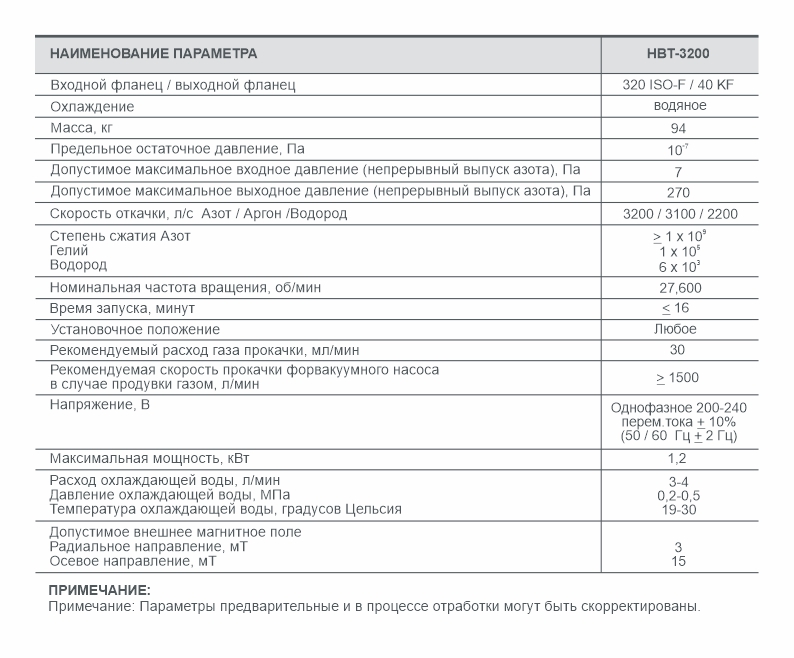
-
Purchase the NVT-3200 Turbomolecular Vacuum Pump
The turbomolecular vacuum pump is an example of how high-speed mechanical engineering and molecular flow physics are combined into an advanced engineering system. These technologies form the foundation of modern achievements in: microelectronics; materials science; fundamental physics research. By controlling the movement of individual gas molecules through a high-speed mechanical system, humanity has gained the ability to create environments close to space vacuum and achieve extremely low pressure conditions. This technology has opened new possibilities for the development of advanced electronics, new materials, and scientific discoveries. A turbomolecular pump represents an effective practical application of molecular physics principles in engineering. One of the greatest risks to reliable pump operation is the ingress of solid particles. If such contamination is possible, a metal protective mesh with a 1 × 1 mm opening size must be installed in the pump inlet flange.
➜ CONTACT OUR SPECIALISTS for selecting vacuum equipment at the manufacturer’s price
➜ VACUUM EQUIPMENT CATALOG is available on the official VACMA.RU website
+7 (843) 278-35-27 kazan@vacma.ru JSC Vacuummash (Vacma) plant: 58 Tulskaya St., Kazan, 420054, Russian Federation